Monolithic vs Microservices- A Practical, No‑Nonsense Guide
Simple explanation of monolithic and microservices architectures with real-world analogies, code examples, pros/cons, and best practices.
Monolithic vs Microservices: A Practical, No‑Nonsense Guide
Choosing between monolithic and microservices architectures can quietly decide how happy (or miserable) your engineering life will be over the next few years.
This guide walks through the basics in a simple, human way:
- What is a monolithic architecture?
- What is a microservices architecture?
- Key differences
- Pros and cons
- Code examples
- Best practices
- An opinionated, real‑world take on when to use what
- References if you want to go deeper
A Simple Real‑World Analogy
One Big Restaurant vs a Food Court
Think of running a food business:
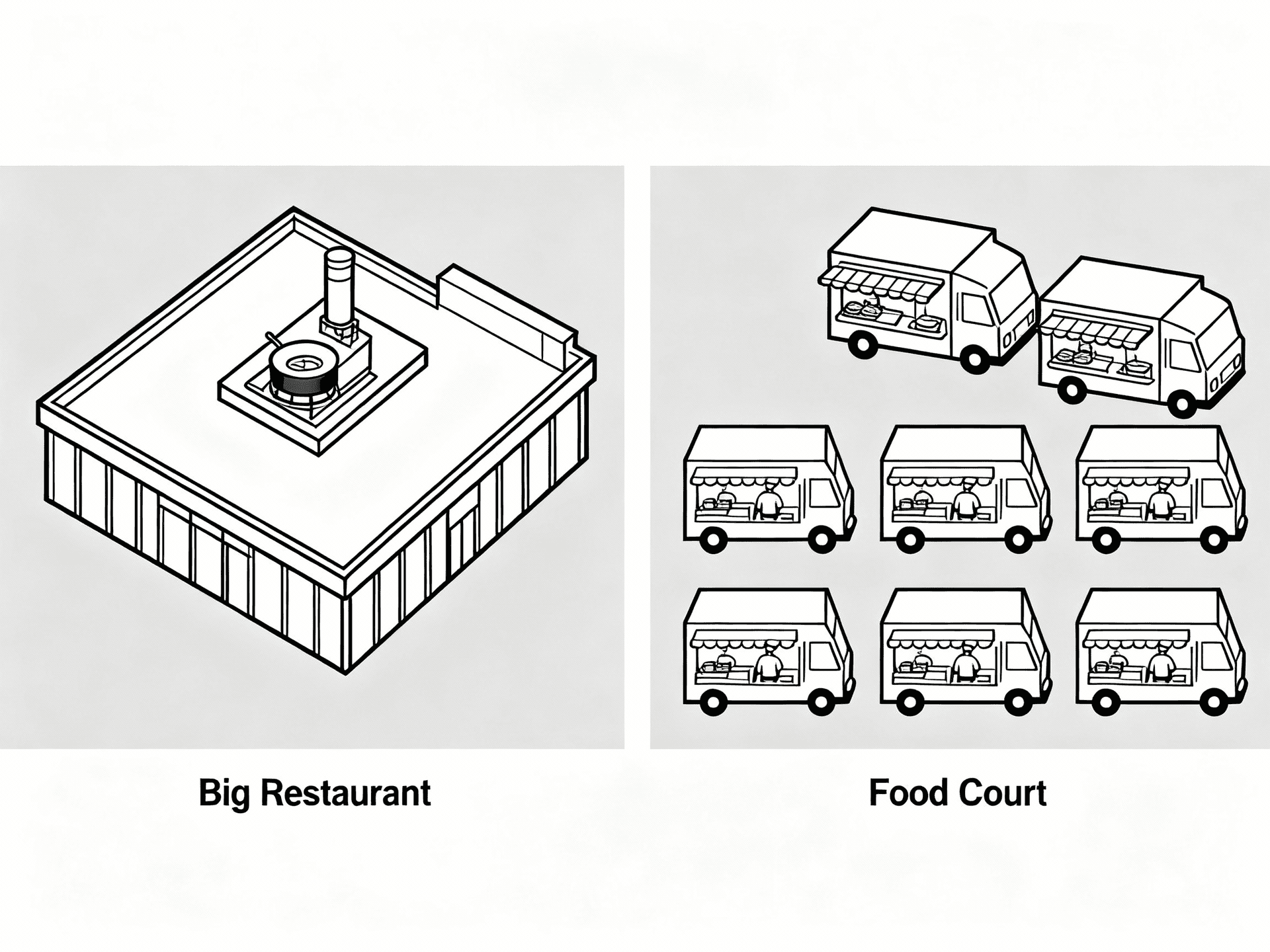
Monolithic architecture is like one big restaurant. One kitchen, one staff, one menu, one bill. Easy to open, easy to manage when small. But if you keep adding cuisines (Indian + Italian + Chinese + sushi + bakery), that single kitchen becomes chaos.
Microservices architecture is like a food court or a cluster of food trucks. One truck does burgers, one does sushi, one does desserts. Each has its own mini kitchen, staff, and mini‑operations. More coordination overhead, but each one can scale and evolve independently.
Software follows the same pattern. Monolith equals one big kitchen. Microservices equals many smaller, specialized kitchens that talk to each other.
What Is a Monolithic Architecture?
In a monolithic architecture, the entire application is built and deployed as one single unit:
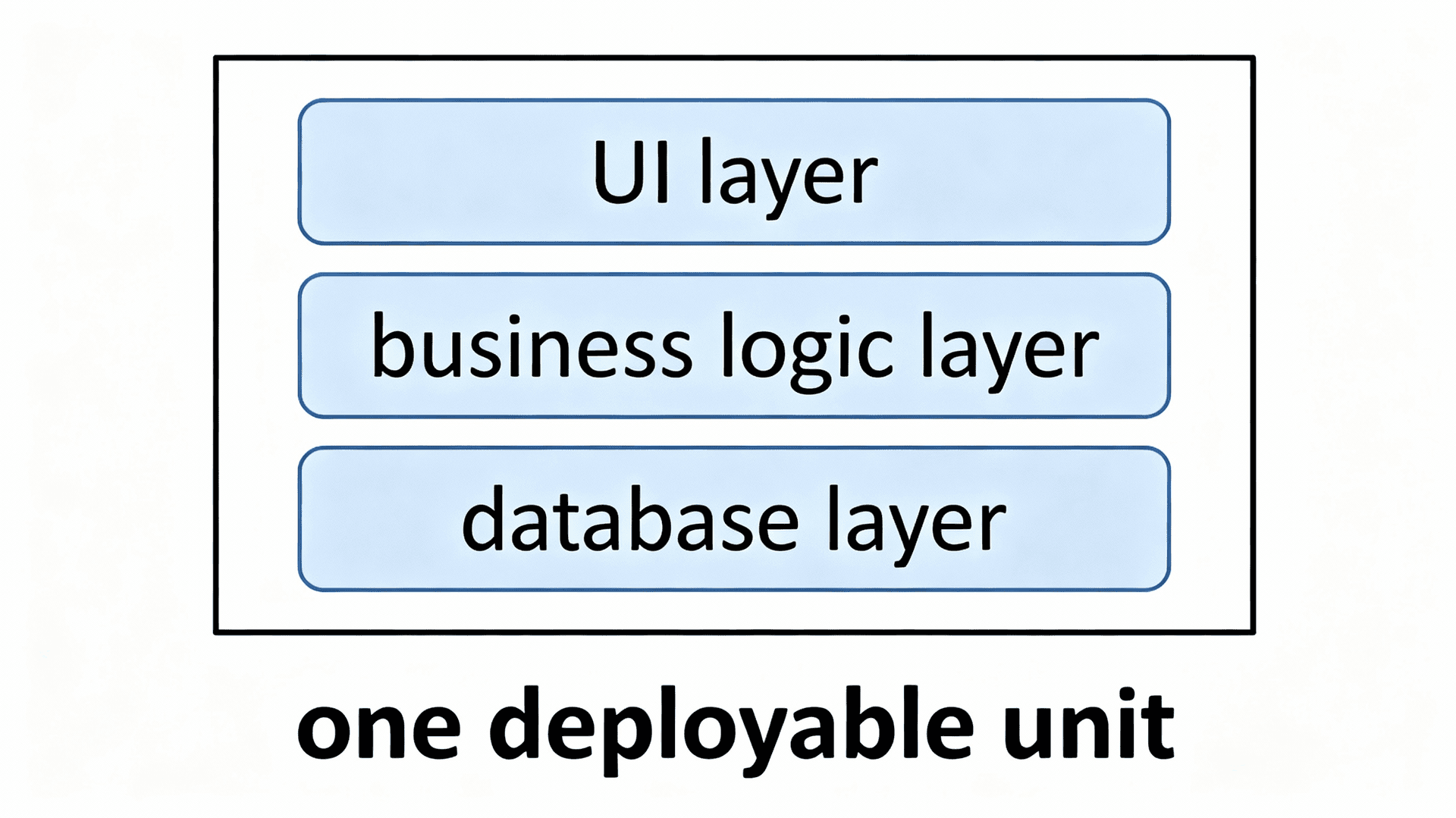
Typical traits:
- One codebase (even if internally modular)
- One deployment artifact (JAR/WAR, single Docker image, etc.)
- Often a single shared database
- Any code change means rebuild and redeploy the whole app
Think of a classic backend where everything lives together: Auth, Users, Orders, Payments, Admin panel, Background jobs. All sharing the same runtime and often the same database.
Key Characteristics of a Monolith
-
Single deployable unit: All features ship together.
-
Shared resources: Common DB, shared models, shared helpers.
-
In‑process communication: Modules talk via function calls, not network calls.
-
Starts simple, can grow into a big ball of mud if not managed: Especially as teams and codebase scale.
Monolith: Small Example (Node.js / Express)
A minimal monolith that handles users and orders in one app:
// app.ts
import express from "express";
import bodyParser from "body-parser";

const app = express();
app.use(bodyParser.json());

// Users
app.post("/users", (req, res) => {
  // Writes to a shared "users" table
  // db.users.insert(req.body);
  res.status(201).send({ message: "User created" });
});

app.get("/users/:id", (req, res) => {
  // const user = db.users.findById(req.params.id);
  res.send({ id: req.params.id, name: "Alice" });
});

// Orders
app.post("/orders", (req, res) => {
  // db.orders.insert(req.body);
  res.status(201).send({ message: "Order created" });
});

app.get("/orders/:id", (req, res) => {
  // const order = db.orders.findById(req.params.id);
  res.send({ id: req.params.id, total: 42 });
});

app.listen(3000, () => {
  console.log("Monolith listening on http://localhost:3000");
});
Everything runs in one process. One build, one deployment, one change pipeline.
Pros of Monolithic Architecture
-
Simple to start with: One project, one pipeline, one runtime. Very low cognitive load.
-
Easier local development: Pull the repo, run the app, connect to a DB. No need to spin up 8 services and a message broker.
-
Straightforward debugging: A request flows through one process. Stack trace, logs, CPU profile, all in one place.
-
Good fit for small teams and early‑stage products: When requirements are changing weekly, complexity from microservices is just overhead.
Cons of Monolithic Architecture
-
Scaling is coarse‑grained: If only the "orders" part is under heavy load, you still end up scaling the entire monolith.
-
Tight coupling over time: As the system grows, modules start knowing too much about each other. A change in one place unexpectedly breaks another.
-
Slower deploy cycles for big teams: Many developers touching the same deployable equals more merge conflicts, more coordination, more "fear deploys."
Limited tech flexibility: Trying a different language or different persistence model for one specific use case is harder.
What Is a Microservices Architecture?
In a microservices architecture, the application is split into multiple small services, each focused on a specific business capability:
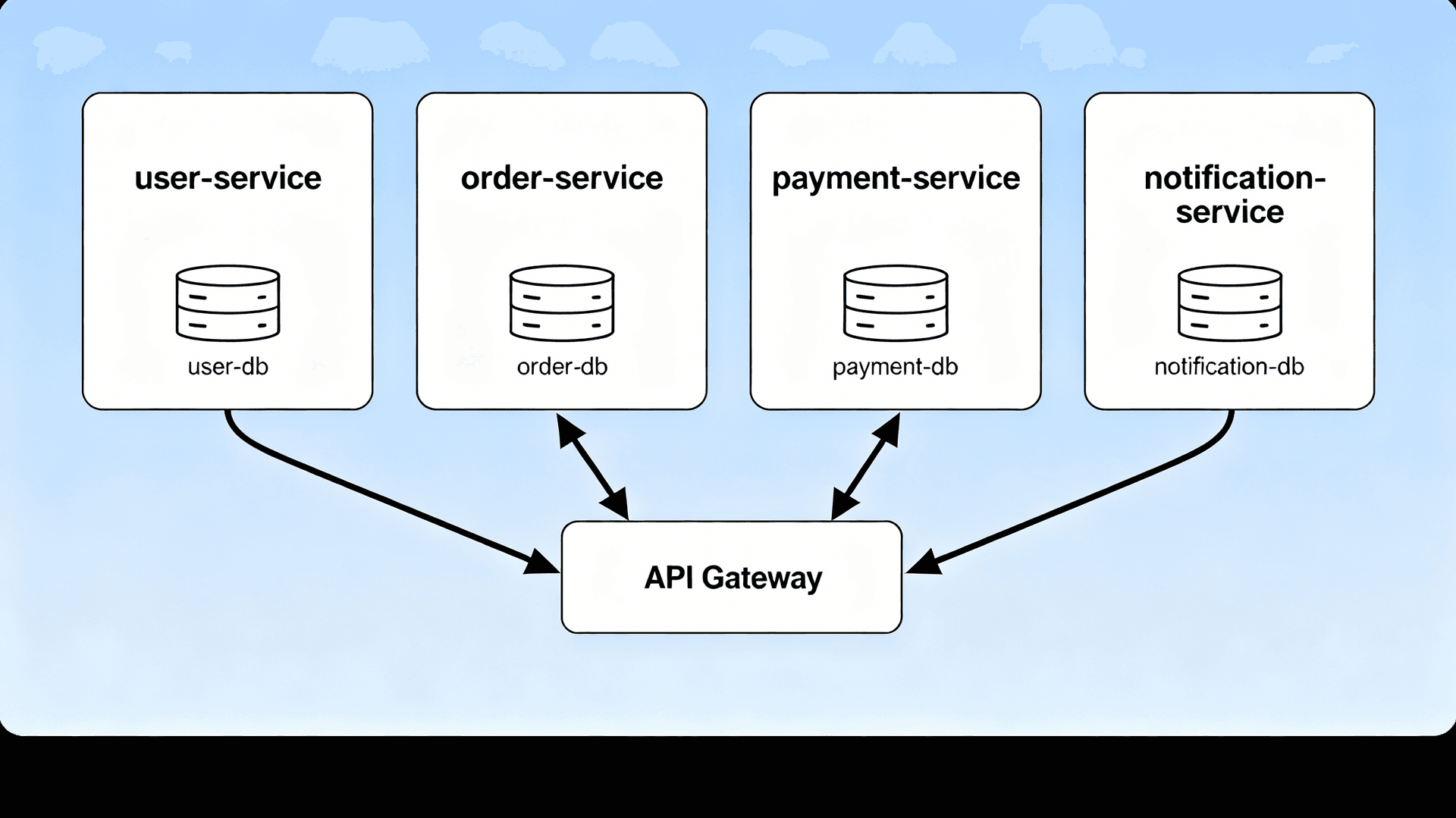
Typical services: user service, order service, inventory service, payment service, notification service.
Each service owns its own codebase, often owns its own database, has a clear focused responsibility, and communicates with others via network calls (HTTP/gRPC/message queues).
Key Characteristics of Microservices
-
Service per business capability: Clear ownership like user domain, order domain, billing domain.
-
Independent deployments: Deploy order service without touching user service.
-
Independent scaling: Scale only the services under heavy load.
-
Distributed by design: Network, latency, partial failures, observability all become first‑class concerns.
Microservices: Small Example
Split the earlier monolith into two services: user service and order service.
user service
// user-service/index.ts
import express from "express";

const app = express();
app.use(express.json());

app.post("/users", (req, res) => {
  // userDb.insert(req.body);
  res.status(201).send({ message: "User created (user-service)" });
});

app.get("/users/:id", (req, res) => {
  // const user = userDb.findById(req.params.id);
  res.send({ id: req.params.id, name: "Alice (user-service)" });
});

app.listen(4001, () => {
  console.log("user-service listening on http://localhost:4001");
});
order service
// order-service/index.ts
import express from "express";
import axios from "axios";

const app = express();
app.use(express.json());

app.post("/orders", async (req, res) => {
  const { userId, items } = req.body;

  // Validate user by calling user-service over the network
  let user;
  try {
    const response = await axios.get(
      `http://user-service:4001/users/${userId}`
    );
    user = response.data;
  } catch (e) {
    return res.status(400).send({ error: "Invalid user" });
  }

  // orderDb.insert({ userId, items });
  res.status(201).send({
    message: "Order created (order-service)",
    user,
  });
});

app.get("/orders/:id", (req, res) => {
  // const order = orderDb.findById(req.params.id);
  res.send({ id: req.params.id, total: 42 });
});

app.listen(4002, () => {
  console.log("order-service listening on http://localhost:4002");
});
In a real system these would sit behind an API gateway, use service discovery, and have proper observability, but the basic shape is clear. Multiple smaller services talking over the network instead of within the same process.
Pros of Microservices Architecture
-
Independent scaling: If only order processing is hot, scale just order service.
-
Independent deployments: Ship new features or fixes to a single service without redeploying the whole platform.
-
Better fault isolation: If the recommendation service is down, checkout can still function (assuming good fallbacks).
-
Team autonomy: Each team can own a service end‑to‑end with design, build, deploy, run responsibilities.
-
Potential tech flexibility: Different services can use different stacks where it genuinely makes sense.
Cons of Microservices Architecture
-
Complex infrastructure: Needs service discovery, load balancing, API gateways, centralized logging, metrics, tracing, and more.
-
Network complexity: Latency, timeouts, transient failures, retries, backoff, circuit breakers become part of daily life.
-
Data consistency challenges: No simple cross‑table joins across service databases. Often relies on events and eventual consistency.
-
Higher overhead for small teams: Too many services with too few people quickly becomes operational drag.
Monolithic vs Microservices: Key Differences
| Dimension | Monolithic Architecture | Microservices Architecture |
|---|---|---|
| Deployment | Single deployable (one app) | Many deployables (one per service) |
| Codebase | One large repo/project | Multiple repos or separated services |
| Communication | In‑process function calls | Network calls (HTTP/gRPC/messaging) |
| Database | Usually one shared DB | Typically database‑per‑service |
| Scaling | Scale the whole app | Scale individual services |
| Fault isolation | Failures can impact the entire app | Failures more isolated (if contracts are respected) |
| Deployment risk | Big bang releases | Smaller, incremental service‑level releases |
| Operational overhead | Lower (simpler infra) | Higher (needs solid platform / DevOps) |
| Best suited for | Small teams, early products, simpler or fast‑changing domains | Larger teams, clear domains, high scale, mature DevOps |
A Concrete Scenario: Adding "Loyalty Points"
In a Monolith
Say the system needs to award loyalty points every time an order is placed.
Because everything shares a DB, it is easy to wrap in one transaction:
async function createOrder(userId: string, items: any[]) {
  await db.transaction(async (trx) => {
    const order = await trx.orders.insert({ userId, items });

    await trx.users.update(userId, {
      $inc: { loyaltyPoints: calculatePoints(order) },
    });
  });

  return { success: true };
}
One transaction means either both order and points update succeed, or both fail. Simple, consistent, easy to reason about.
In Microservices
Now imagine order service owns orders and its own DB, while user service (or loyalty service) owns user data and points in a different DB.
A common pattern uses events:
// order-service
async function createOrder(userId: string, items: any[]) {
  const order = await orderDb.insert({ userId, items });

  await eventBus.publish("order.created", {
    orderId: order.id,
    userId,
  });

  return { success: true };
}

// loyalty-service
eventBus.subscribe("order.created", async (event) => {
  const { orderId, userId } = event;
  const order = await orderDb.findById(orderId); // or pass whole order in event

  const points = calculatePoints(order);
  await userDb.incrementLoyaltyPoints(userId, points);
});
Now there is eventual consistency where points might lag behind order creation, idempotency where the consumer needs to handle duplicate events safely, and error handling for failed updates.
More complexity, but better decoupling and separation of responsibilities.
Best Practices for Monolithic Architectures
A monolith does not have to be a mess. A modular monolith can be very healthy.
-
Keep clear internal boundaries: Organize code by domain like users, orders, billing. Avoid shared "god" modules.
-
Use internal interfaces / service layers: Treat internal modules a bit like separate services (with boundaries), just running in the same process.
-
Centralized, well‑structured data access: Repositories or data access layers per domain instead of ad‑hoc queries everywhere.
-
Automate testing and deployments early: CI, unit tests, integration tests, and a smooth deployment pipeline keep the monolith manageable as it grows.
Good monoliths are also easier to split into microservices later, because boundaries are already somewhat clean.
Best Practices for Microservices Architectures
When microservices are the right choice, a few things are absolutely non‑optional:
-
Well‑defined bounded contexts: Each service should have a focused, understandable responsibility. No "misc" dumping‑ground services.
-
Strong data ownership: One service owns a given piece of data. Other services consume it via APIs or events, not by directly poking another service's DB.
-
Serious observability: Centralized logs, metrics, tracing, dashboards, alerts. Without them, debugging becomes guesswork.
-
Careful API and event design: Treat contracts as stable public interfaces. Think about backward compatibility and versioning.
-
Automated infra and CI/CD: With multiple services, manual deployment does not scale. Templates, pipelines, and platform support matter.
-
Keep the number of services reasonable: "Microservices" doesn't mean "split everything into 50 services on day one." Extract services where there is clear value.
Opinionated, Real‑World Take
A few patterns show up again and again in real systems.
If the product is early and the team is small, a clean, modular monolith is usually the better bet.
Microservices shine when there are multiple teams stepping on each other's toes in the same codebase, some parts of the system need very different scaling or release cadences, and the organization already has solid infra, observability, and on‑call practices.
A healthy path many teams follow:
- Start with a modular monolith
- Enforce clear internal boundaries between domains
- When a domain becomes a bottleneck (scale, ownership, or release speed), extract it into a microservice
- Repeat for the areas where it clearly brings real benefits
The key point: Architecture should follow actual pain, not slides or hype.
References
- Martin Fowler: "Microservices" and "Monolith First"
- Sam Newman: Building Microservices
- Neal Ford, Mark Richards: Software Architecture: The Hard Parts
- ByteByteGo: System Design Interview
- Google Cloud Architecture Guides: Monoliths vs Microservices trade‑offs
- AWS and Azure architecture docs: migration strategies from monoliths to microservices
Thanks for reading.